
What Shows Up
Some stories arrive fully formed. Others only become visible when someone listens closely enough to help us find them.
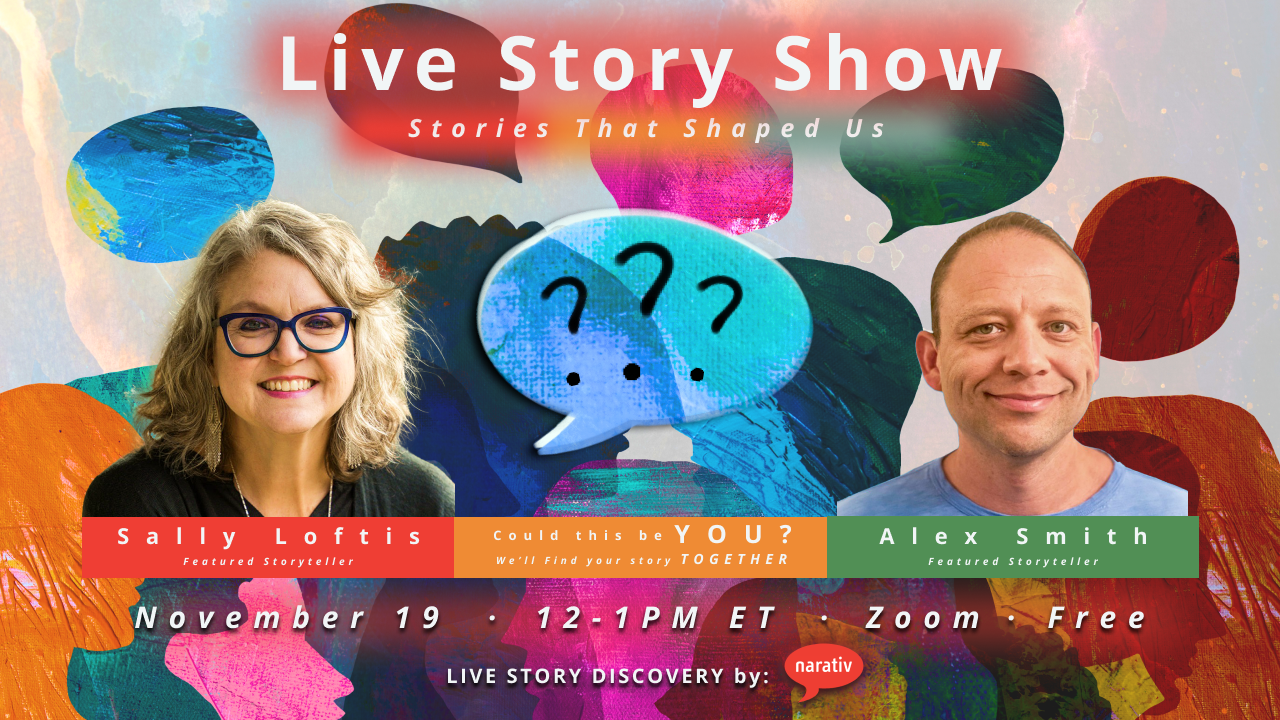
That was part of what made this edition of Stories That Shaped Us, the Leadership Story Talks LIVE Story Show, feel different. Jerome Deroy and Julienne Ryan welcomed three storytellers into a shared space built around attention rather than performance. Sally Loftis and Alex Smith brought stories they had already shaped through experience and reflection. George Hanover did something more exposed: she agreed to discover a story in real time, without a script, by allowing Jerome and Julienne’s questions to lead her back into moments she had not expected to revisit.
The stories were very different, but as the hour unfolded a connection began to appear between them. Each was about a difficult or uncertain moment, but none of them stayed focused only on the difficulty. Instead, they revealed what appeared alongside it: another person, a forgotten memory, an unexpected source of courage, or the realization that the thing we thought we had lost may still be with us in another form.
Trusting What Will Come
Sally Loftis’s story began in September 2024, only three weeks after she became executive director of a food pantry in Avery County, North Carolina. Then Hurricane Helene hit the Blue Ridge Mountains.
Sally described leaving her own property after clearing enough fallen trees to get out and driving through a landscape that had become almost unrecognizable. Roads and bridges were gone. Businesses had been washed away. Some communities were reachable only by helicopter. People stood looking at what remained of homes and livelihoods, stunned by the scale of the destruction.
She had no experience of disaster response and no real frame of reference for what she was facing, so she went to the county emergency operations center and did what she instinctively does when entering an unfamiliar situation: she asked for guidance. A federal emergency-management official told her that she was about to witness an avalanche of generosity. He urged her to distribute food as quickly and freely as possible. Sally’s immediate reaction was practical. What if they ran out?
It was a reasonable fear. The food system across western North Carolina had been badly damaged. Farms and community gardens had been affected, grocery distribution centers were disrupted, and the Asheville food bank that supplied hundreds of pantries had been wiped out. The official told her to trust that help would come.
So she did.
The pantry reopened, and people began to arrive. Hundreds of volunteers showed up in the first weeks. Local businesses brought food for those volunteers. Military vehicles came at night to restock supplies. Donations began arriving from around the country and beyond. Over the following year, the pantry raised several times its normal annual operating budget.
But the heart of Sally’s story was not the scale of the operation. It was what happened between people.
For some neighbors, the pantry volunteers were among the first people they saw after the storm. Many had been isolated without phone service or internet and had little idea what had happened outside their immediate surroundings. They came for food and supplies, but they also came into contact with other human beings who could reassure them that they were not alone. Sally remembered people collapsing into her arms simply because they were relieved to see someone alive and able to help.
The daily lunches shared by volunteers gradually became a kind of ritual. People sat together, ate together, talked, and began to absorb what they had been through. The pantry was distributing food, but it was also creating a place where people could begin to recover in community.
The generosity Sally had been told to trust did arrive. It came in money, supplies, labor, meals, and military trucks. But it also came in presence.
Finding a Story in Real Time
The format shifted with George Hanover, an actor, facilitator, entrepreneur, and co-artistic director of Broken Crow Theatre Company in Ireland. George had answered an invitation asking whether someone in the audience might be willing to tell a story live. She said yes, even though she did not yet know what story she wanted to tell.
That uncertainty became the point.
Jerome and Julienne began not by asking for a lesson or a polished anecdote, but by asking why George had felt drawn to tell a story at this particular moment. She spoke about starting her own business and finding herself unexpectedly confronted by a version of herself she thought she had left behind: the shy child.
The contrast was striking because George is an actor. She can perform in front of a large audience and feel entirely at home. Yet stepping forward in her own voice, on behalf of her own work, felt different. Acting was a familiar kind of discomfort. Entrepreneurship was bringing back a much older one.
Jerome asked her to show them the shy child.
George remembered herself at six or seven years old in a busy Irish family home with seven children. When relatives or family friends came to visit, she sometimes found herself stranded in the hallway, unable to enter the sitting room. If she opened the door, everyone might turn and look at her, and that possibility felt unbearable. So she waited outside until her mother eventually emerged to make tea. Then, in the bustle of the moment, George could slip into the room almost unnoticed.
It was a small memory, but in telling it she made that child visible.
Jerome then followed the contrast. How did the child who could barely enter a room become an actor? George remembered a school play when she was around eleven or twelve. She did not get the part she wanted, but she did get a role. What she remembered most clearly was not the rehearsal process or even the details of the play. It was how she felt onstage.
She felt as though she were flying. The child who had once waited behind a door because she could not bear being seen discovered a place where being seen felt natural.
George had thought often about her childhood shyness. What surprised her was being taken back to that second memory, to the physical feeling of being onstage and discovering another version of herself. Suddenly the story she might need now did not seem to be only about fear or finding a voice. It might also be about remembering that she had already crossed that threshold once before.
As she steps into a new business and feels the impulse to retreat, perhaps the twelve-year-old who once felt herself flying has something to offer.
The Meaning Inside the Moment
Alex Smith’s story began with a very different kind of impact. Seven years ago, he said, it had felt as though life had hit him with a fleet of tractor trailers.
After seven years with his company, Alex was suddenly let go. A month later, his father called to tell him he had leukemia. Soon afterwards, while Alex was standing in line at the Florida unemployment office, his mother called to say his father’s cancer had accelerated and that he needed to come home.
The story could easily have become one about anger and loss, and those emotions were certainly there. Alex spoke openly about being furious with life and frustrated by the sense that everything had happened at once. But the story gradually moved toward something more complicated.
When Alex visited his father in the ICU, he brought him a book about the year he was born. His father opened it, saw Winston Churchill, raised a hand from his hospital bed and launched into an impression. Even surrounded by tubes and uncertainty, he was still himself.
The doctors told the family there were few options left. Alex and his mother made the painful decision to move his father into comfort care. Yet instead of the immediate ending they had expected, something else happened. His father improved enough to leave the hospital for a time. Friends came to see him, sat with him, held his hand, cried, laughed, and told stories.
Alex began to see his own job loss differently. Losing the job had been devastating, but it had also given him the freedom to be there. He had been able to share hundreds of ordinary moments with his father that he might otherwise have missed.
That did not make the job loss good. It did not make the illness good. It simply meant that the story contained more than one truth.
A month later, when his father was back in the hospital, Alex ended a phone call by reminding him to breathe and telling him he loved him. A minute later, a text arrived from his father, who could barely use his phone: the “uh-oh” emoji. Then the three dots appeared, and went away. Alex sat down and wondered whether, after thousands of conversations, that would be their last.
Those words became the emotional center of the story. His father is no longer physically present, but the message remains, and so does the relationship Alex continues to have with him through memory.
The Story Is in the Specifics
As Jerome and Julienne reflected on the stories, they returned to one of the central ideas behind Leadership Story Talks: a powerful story does not depend on spectacle. It depends on experience made specific enough for another person to enter.
Sally’s story gave us military trucks arriving after dark, strangers collapsing into hugs, and volunteers gathering around lunch tables after a disaster. George gave us a child waiting behind a door for her mother to come out and make tea, then years later standing under stage lights and feeling as though she were flying. Alex gave us an ICU bed, a Churchill impression, a text message, and a handwritten line discovered inside a book.
None of those moments is powerful because it is grand. They are powerful because they are particular.
Specificity allows the listener to see the experience rather than simply hear what it meant. We understand Sally’s belief in generosity because we have watched people show up. We understand George’s shyness because we have stood with her in the hallway. We understand the relationship between Alex and his father because we have heard their voices. The meaning comes through the moment rather than being placed on top of it.
Listening Makes the Story Possible
George’s live story discovery made the role of listening especially visible.
She did not arrive knowing what the story would be. Jerome and Julienne listened for contrast, noticed the words she used, and followed what made them curious. They asked her to go back to an experience rather than rushing toward interpretation, and that process uncovered a memory she had not been thinking about at all.
It is a reminder that we often believe our important stories should already be obvious to us. We assume that if something mattered, we would know exactly what it meant and how to tell it. But some stories remain hidden precisely because they are so familiar.
Another person may hear a phrase we barely notice. They may ask about a detail we had dismissed. They may see a connection between two moments we have always kept separate. Listening does not simply receive a story. It helps create the conditions in which the story can be found.
That same trust appeared later when Alex, reflecting on his story, struggled to remember the exact wording of a quotation. He paused, restarted, and searched for it in front of everyone. Julienne noticed that even this imperfect moment demonstrated something about the space they had created. Alex trusted the listeners enough not to perform certainty. He could search for the words, get tangled in them, and keep going.
The story did not need to be picture-perfect in order to be true.
What Was There Alongside It?
Toward the end of the show, Sally noticed something connecting all three experiences. Difficult things had happened in every story, but something had also shown up alongside them.
That is perhaps the most useful thread to carry away from this edition of Stories That Shaped Us. The point is not that hardship contains a hidden gift, or that grief, disaster, and fear should be converted into neat lessons. The stories did not ask us to pretend that difficult experiences were anything other than difficult.
They asked us to look more closely.
When Sally looked at the aftermath of Helene, she saw destruction, but she also saw people coming toward one another. When George revisited her shyness, she rediscovered the child who had already found a place where she could fly. When Alex looked back at one of the hardest periods of his life, he found the time he had been given with his father and words that would continue speaking long after his father was gone.
Stories allow those things to exist together. They give us enough room to hold what hurt and what helped, what disappeared and what remained, who we were before an experience and who we discovered ourselves to be inside it.
Sometimes meaning does not arrive while an experience is happening. Sometimes we find it years later when we tell the story. And sometimes we find it because someone else is listening closely enough to ask the question that takes us back there.
That may be one of the deepest values of storytelling. We do not only discover what happened. We discover what else was there.
LISTEN to Sally, George and Alex’s stories on the LIVE Storytelling Show HERE
The next Live Story Show is on Thursday, January 21, 2027. We’d love to have you join us.
Experience The Listening Lab
Is there something hard to communicate right now: a presentation, a difficult conversation, a big change?
The Listening Lab is a small, confidential group that meets once a month on Zoom to practice really listening, to each other and to ourselves. Members bring what they’re working through, and the group listens and asks questions before anyone jumps to advice.
Your first month is free after a short application and a 15-minute fit call ~