By Jerome Deroy with contributions from Charles Bernard and Julienne Ryan
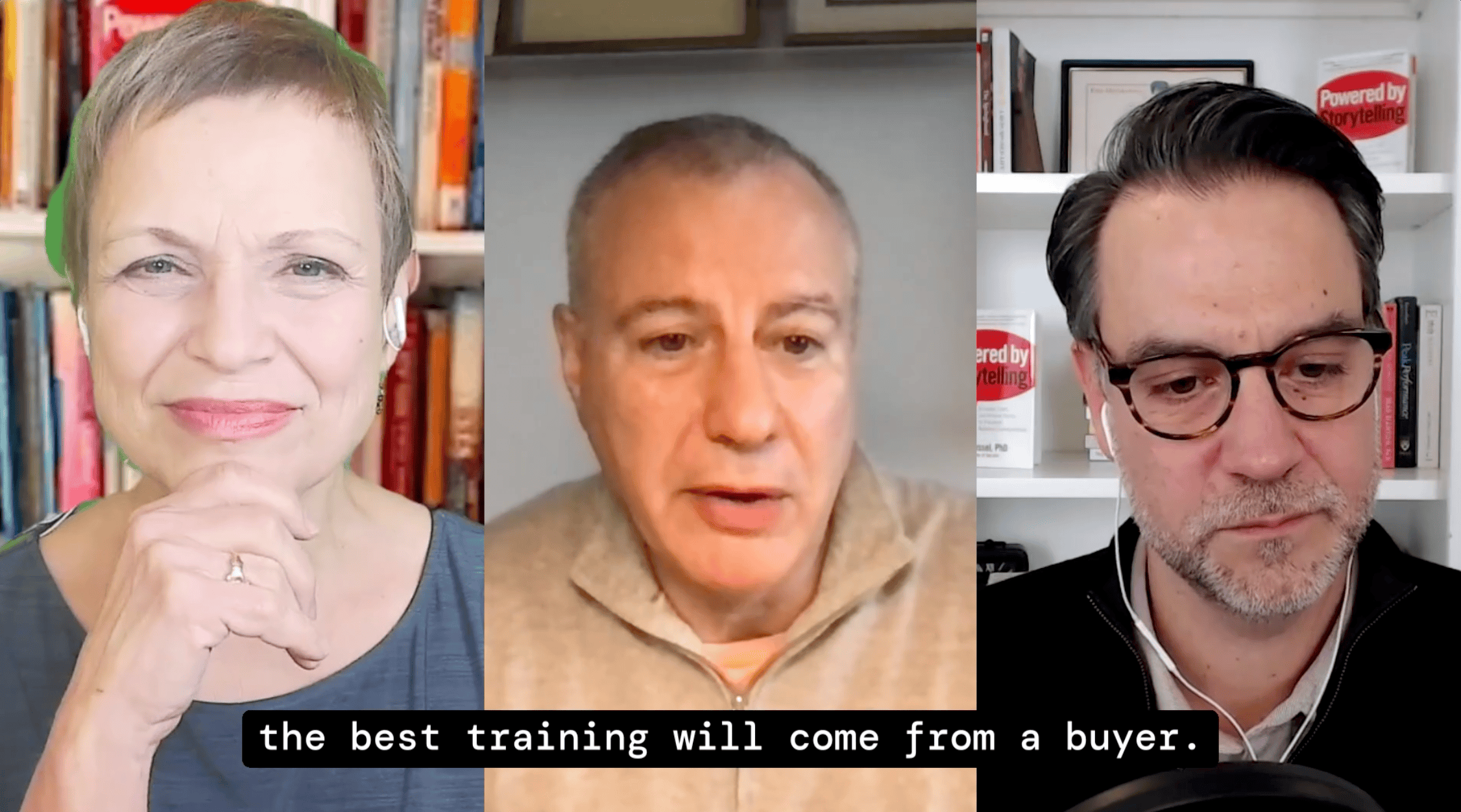
L-R Julienne Ryan, Charles Bernard & Jerome Deroy
The Pressure System We’ve Built
In a recent conversation I had with Charles Bernard, founder of Criteria for Success, and Julienne Ryan, organizational storyteller and leadership consultant, we all agreed on one thing: sales today is an identity crisis waiting to happen.
“When a salesperson hits their goal,” Charles said, “they feel validated. When they don’t, they spiral. Their entire sense of self can hinge on one number.”
It’s not just a sales problem. It’s an organizational problem — one that reveals how companies measure worth, effort, and even belonging.
As Julienne put it, “We’ve built cultures where the first question is always, ‘Did you hit your target?’ instead of, ‘What did you learn about your customer?’ or ‘How did your team grow?’”
The result? Burnout, short-term thinking, and a fear-driven hamster wheel of activity. Sellers chase transactions instead of relationships, while buyers — under their own pressures — brace themselves against the very people trying to help them.
That cycle of pressure, identity, and fear is the water most of us swim in. But it doesn’t have to be.
Why It Matters Now
The stakes for changing this paradigm are higher than ever. Markets are uncertain. AI is reshaping how value gets delivered. Buyers are overwhelmed with choices and underwhelmed by differentiation. And yet the typical sales playbook hasn’t evolved much: hit quota, send more emails, do more demos, follow the script.
“It’s all left-brain dominated,” Charles observed. “Leaders keep adding goals. More KPIs, more initiatives, more dashboards. But nobody’s stopping to ask, ‘What can we remove?’”
In our discussion, he described the toll of what he calls goal fatigue: “It’s not just that people are tired. It’s that they’ve lost the connection between what they’re doing and why they’re doing it.”
Julienne agreed, adding that when people lose that connection, they stop listening. “We forget that selling — like leadership — is fundamentally about being curious. When you stop being a learner, you stop earning trust.”
These aren’t abstract issues. They show up in real numbers: sales teams report they miss quota expectations of 67%, and 84% missed their quota last year, according to Salesforce’s State of Sales report. Annual turnover among salespeople runs as high as 27% — roughly twice the rate of the overall labor force — and some organizations report attrition exceeding 30%. Each 5% rise in sales attrition can increase selling costs by 4–6% and cut revenue by nearly 20%, according to Xactly. And buyers feel it too — 59% say sales reps don’t take the time to understand them, while 84% expect those reps to act as trusted advisors.
When people lose connection to purpose, companies don’t just lose morale — they lose money, continuity, and trust.
So if the system we’ve built is producing more anxiety than meaning, the question becomes: what replaces it?
From “Getting To” to “Coming From”
One of the frameworks we explored together comes from Narativ’s storytelling work with leaders and teams: the idea of future storytelling — telling the story of a desired future as if it has already happened.
Instead of saying, “We need to hit $10 million this year,” you say, “It’s 2027. We’ve just led our team through its best year yet, and here’s what made it happen.”
It’s a subtle but profound shift.
“When you do that,” I explained to Charles and Julienne, “you’re no longer chasing a number. You’re orienting yourself around a purpose and an impact that already exists in narrative form. You’re moving from getting to a goal to coming from a future that you’ve defined.”
Charles nodded. “That’s the thing — when I was most successful early in my career, it wasn’t because I was trying to sell. It was because I was trying to make the buyer successful. I didn’t know any sales methodology back then. I just knew I wanted to help.”
That perfectly captures the bridge between storytelling and sales — the move from doing to being.
“Be the Buyer”: The Mindset Shift That Changes Everything
Charles has a mantra he returns to often: Be the buyer.
At first, it sounds like a clever slogan. But as he unpacked it, it became clear it’s the foundation of a new kind of selling.
“When I was in my twenties,” he recalled, “I worked with a client at Mobil Oil. I didn’t know the first thing about sales. But I knew I wanted him to succeed. I spent every ounce of energy trying to understand what success looked like for him. And that’s what made the relationship work.”
Later, he realized there was no technique behind it — just presence. “You can learn every sales methodology in the world,” he said, “but none of it compares to what you learn when you step into the buyer’s world. You can’t teach that as a formula. You have to be it.”
Julienne added, “It’s the same in any human relationship. The moment you visit someone in their natural habitat — not to sell, but to listen — everything changes. You stop objectifying them and start learning from them.”
That act of “being the buyer” is empathy in motion. It’s also storytelling at its most practical. When you inhabit another person’s perspective, you naturally start narrating their journey — their challenges, their hopes, their future.
And that’s where the link to future storytelling becomes so powerful: you can’t tell a future story without empathy. You can’t backcast a plan without understanding what success means for the other person.
Why Listening and Futuring Belong Together
Listening is the hidden muscle behind all transformation.
In our conversation, Julienne put it beautifully: “When a seller truly listens, they’re not just gathering information. They’re giving the buyer permission to think out loud. That’s when new ideas show up.”
That permission is also what allows future storytelling to work. When a team imagines a future story together — “It’s three years from now and here’s what we’ve achieved” — they’re not predicting the future. They’re listening to it. They’re drawing out what already lives in the collective imagination and giving it form.
The key, as Charles said, is to make it actionable through backcasting: “You start with the future story, and then you walk it backward into the present. You ask, ‘If that’s true three years from now, what would we have done six months ago to make it happen?’”
That’s how imagination becomes practice. And it’s how pressure turns into purpose.
The Cultural Cost of Staying Stuck
It’s tempting to dismiss all this as “soft stuff.” Many leaders still do. “Sure,” they say, “storytelling sounds nice, but I have payroll to make.”
That’s the point. The payroll gets harder to make when your people are burned out, disengaged, or chasing meaningless KPIs.
As Charles noted, “We’ve created organizations that objectify both sellers and buyers. Everyone becomes a data point. But if you talk to buyers, they’ll tell you they’re tired — tired of being asked the same discovery questions by twenty salespeople who don’t really listen.”
Julienne added, “When we treat relationships as transactions, we train people to stop caring. And that’s when innovation dies.”
The cost isn’t just human; it’s strategic. In a world of AI-generated pitches and endless automation, the only real differentiator left is how deeply you listen and how clearly you connect your story to someone else’s reality.
Future storytelling and “be the buyer” aren’t feel-good ideas — they’re competitive advantages. They build trust faster, sustain momentum longer, and anchor teams in meaning when everything else is uncertain.
The Mechanics: From Idea to Action
If this is the mindset shift, what does it look like in practice?
Here are three ways leaders and teams can start now:
1. Write Your Future Story
Gather your team and say:
“It’s 2027. We’ve just completed our most impactful year. Our clients are saying X has changed for them. Here’s how we did it.”
Write it in the past tense. Make it vivid and specific — who was there, what you learned, what difference it made. Then ask: What had to be true for this story to happen?
That’s your backcast.
2. Run a “Buyer Chair” Exercise
In your next pipeline meeting, pick one real opportunity. Have one person play the buyer and another play the seller.
Ask the “buyer” to describe what pressures they’re under — political, emotional, organizational. Then have the “seller” respond from that frame.
The question to end with: “What did we learn about this person’s world that changes what we’ll do next?”
3. Remove Three Goals
This one’s from Charles. Once a quarter, remove three initiatives, metrics, or targets that no longer serve the story. Create space for thinking and learning. Then fill that space with future storytelling sessions or Buyer Chair reflections.
As Julienne said, “If we don’t give ourselves time to reflect, we just go back to where we always were. You can’t innovate from exhaustion.”
Why This Is the Work
At the end of our conversation, I said something that surprised even me:
“We’re not asking people to do something different. We’re asking them to be different.”
Julienne nodded. “Exactly. If we don’t believe this part is important, it won’t come across as important. But this is the work — learning how to listen, how to imagine, how to be a learner again.”
Charles summed it up simply: “People don’t buy from sellers. They buy from humans who understand them. Be the buyer.”
Call to Action
If you’re a leader, start by telling your own future story.
If you’re a salesperson, spend a day being your buyer.
If you’re an organization, retire goals that no longer connect to purpose.
Because the next era of sales won’t be led by those who chase harder — it’ll be led by those who listen deeper and lead with story.
Check out the Listening Lab here ~ LISTENING LAB
Want More Leadership Story Talks?
Narativ’s online course in partnership with New Mexico State University Global Campus:
Lead With Your Story (self-paced, on-demand course)
Podcast listeners get 25% off – Use code NARATIV → Register Here
Learn more about how to leverage Narativ’s storytelling method for your pitch and sales team: Download our free e-book, or you’re welcome to schedule a free 15-minute call with Jerome.